

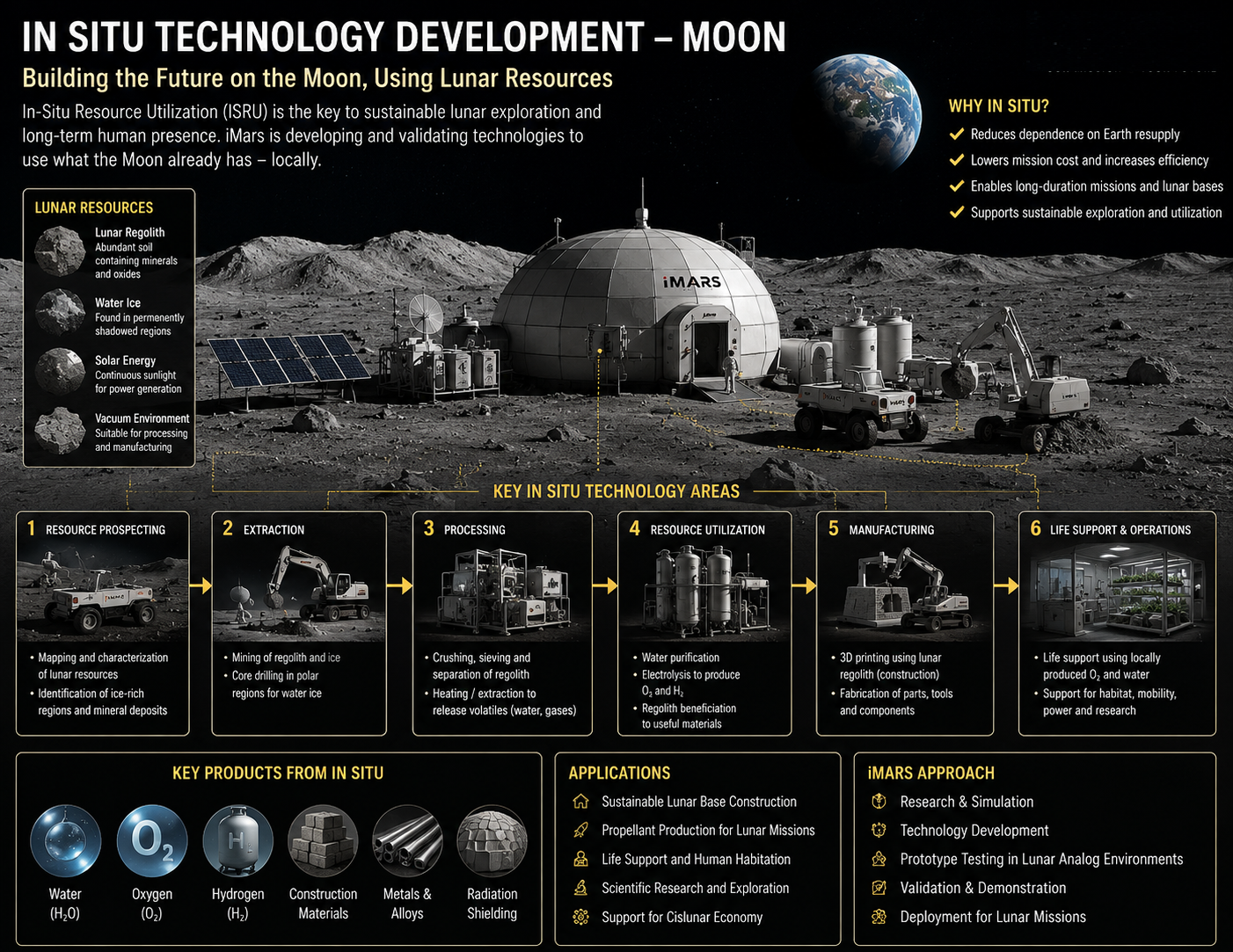
In-Situ Technology Development Building Self-Sustaining Systems for Moon and Mars Exploration
The iMars Organization is focused on advanced In-Situ Technology Development to enable sustainable human presence on the Moon and Mars by significantly reducing dependence on continuous supply missions from Earth. For long-duration lunar and Martian missions, transporting every resource from Earth is economically expensive, technically challenging, and operationally unsustainable. Therefore, the future of human settlement beyond Earth depends on the ability to utilize locally available resources for survival, habitat development, power generation, mobility, and long-term mission sustainability.
Our in-situ development program is centered on creating practical engineering systems that can convert local planetary resources into usable materials for construction, life support, and infrastructure development. This includes the utilization of lunar and Martian regolith, subsurface ice deposits, atmospheric gases, solar energy, and thermal energy for producing oxygen, water, structural materials, radiation shielding, and energy systems.
A major focus area is In-Situ Resource Utilization (ISRU), where technologies are developed to extract and process essential resources directly from the Moon and Mars. For lunar missions, this includes oxygen extraction from lunar regolith, ice mining in permanently shadowed craters, and regolith-based construction materials. For Mars missions, the focus includes oxygen production from the carbon dioxide-rich Martian atmosphere, water recovery from subsurface ice, methane production for fuel generation, and regolith processing for habitat construction and surface infrastructure.
Regolith-based construction is one of the most critical aspects of the program. Instead of transporting heavy construction materials from Earth, iMars is developing methods to use local soil for building habitats, landing pads, roads, protective walls, and radiation shielding structures. This includes regolith compaction systems, sintering technologies, regolith brick manufacturing, robotic excavation, and 3D printing systems capable of autonomous construction in harsh extraterrestrial environments.
Life-support sustainability is another key pillar of in-situ technology development. iMars is working on closed-loop environmental control and life-support systems that include oxygen generation, carbon dioxide recycling, water purification and recovery, waste recycling, food production systems, and thermal regulation. These systems are essential for reducing mission resupply requirements and supporting permanent human habitation.
Energy generation and thermal management are also critical for lunar and Martian operations. The program includes solar power systems, thermal storage solutions, habitat insulation technologies, underground habitat concepts, and energy-efficient infrastructure capable of surviving extreme temperature variations. Radiation protection solutions using regolith shielding and partially buried habitats are also being developed to protect astronauts from solar and cosmic radiation.
All these systems are tested and validated through Moon and Mars Analog Research Stations developed by iMars, where environmental conditions such as temperature extremes, reduced atmospheric pressure, low air density, lighting conditions, and regolith interaction are simulated. These analogue stations serve as engineering testbeds for validating habitat systems, robotic operations, excavation technologies, rover mobility, astronaut procedures, and construction techniques before deployment in actual space missions.
The program follows an innovative Commercial Off-The-Shelf (COTS) and modular engineering approach, allowing faster development cycles, lower costs, and improved reliability through the use of proven industrial technologies. This methodology encourages rapid prototyping, collaborative testing, and scalable infrastructure development suitable for both robotic precursor missions and permanent human settlements.
The initiative also promotes strong collaboration among universities, research institutions, startups, industries, government agencies, and international organizations such as Mars Society USA and global analogue mission programs. This collaborative ecosystem supports research, innovation, student participation, astronaut analogue training, and technology demonstrations, creating a strong foundation for India’s contribution to future Moon bases and Mars settlements.
Through this comprehensive in-situ technology development program, iMars aims to create scalable, reliable, and cost-effective systems that support self-sustaining lunar bases and future human civilization on Mars. The long-term vision is not only exploration, but the establishment of permanent human settlements beyond Earth through practical engineering and collaborative innovation.
Request for Support
We invite industries, institutions, investors, philanthropists, research organizations, and visionaries to support this ambitious mission through financial assistance, strategic partnerships, collaborative development, and infrastructure support. Your contribution will help accelerate in-situ technology innovation and play a direct role in building humanity’s future on the Moon and Mars